One of the first questions I’m typically asked whenever I meet with a potential client is: “What should I invest my money in?”
Maybe they’ve previously worked with a financial advisor who invested their money in all sorts of seemingly random investment funds. They probably had no clue what those funds were, aside from the list of 20 random names on their account statement every quarter. And, they may have even been disappointed by the performance of those funds. They may turn on the news and hear about the stock market being at record highs, but they just don’t know what investments to choose. Are stocks right for them? If so, which ones? What about bonds? How much should they invest in each?
In short, most of them have no idea what the “right” answer is. To them, picking successful investments has about the same odds as winning at the casino – a crapshoot at best.
They probably are hoping that I have some magical investment scheme that will somehow result in their investment portfolio increasing in value every year, without exposing them to any risks of market crashes. If only it were that easy…
The truth is, even as someone who has been paying attention to the world of finance for more than 20 years, I still haven’t stumbled on that magical investment. When I do, I promise that my clients will be the first people to know about it!
So, in the absence of that magical investment, how do I invest my money? The answer, to me, is simple: index funds.
So, what is an index fund?
In terms of a technical definition, index funds are investments that attempt to “track” the investment returns of some underlying market index. For the purposes of the discussion in this post, I will focus on stock market index funds, but there are other types of index funds as well, including bond market index funds.
What does that mean, exactly?
Have you ever watched the news at night and heard that the S&P 500 was up 100 points, that the Dow Jones Industrial Average dropped by 1 percent, or that the NASDAQ hit a new record high? The S&P 500, Dow Jones, and NASDAQ are all examples of stock market indexes. Each index includes a “bucket” of stocks that it tracks.
The easiest example is the S&P 500, which tracks the value of 500 of the largest companies in the United States. Every major company you can probably think of is part of the S&P 500: Amazon, Google, Microsoft, Apple, Coca-Cola, Pepsi, Home Depot, AT&T, Verizon, Johnson & Johnson, Visa, and American Express, just to name a few.1
When you hear that the S&P 500 went up, or went down, that is telling you something about how much the value of these 500 companies changed as a group. Importantly though, even when the S&P 500 goes up, there are likely individual stocks within the S&P 500 that have gone down. And the opposite is also true: when the S&P 500 goes down, there may be some stocks within that index that increase in value.
The objective of index funds is to try to copy the movements of the index as a whole. So, an S&P 500 index fund would accomplish that by purchasing and holding stocks in each of the 500 companies that are part of the S&P 500 index. These index funds buy all 500 stocks, without thinking any further about which stocks are going to perform better than others.
What are the benefits of investing in index funds?
Investing in index funds is often referred to as “passive” investing (as compared with “active” investing). Passive investing can often be thought of as investing in the stock market as a whole. Instead of trying to pick which stocks are the “winners” and which are the “losers,” passive investing means willingly investing in both winners and losers.
Overall, investing in index funds has the following major benefits:
Diversification: Diversification is often called the only “free lunch” in investing. The idea is simple. Investing in a bunch of different companies across different industries reduces volatility relative to investing in one company. If you are only invested in one company and it goes bankrupt, you lose everything. But if you are invested in 100 companies, the other 99 may have done well enough that you don’t even notice when one investment doesn’t work out. The S&P 500 contains 500 companies that represent approximately 80 percent of the value of all publicly-traded companies in the United States, and over 50 percent of the value of all publicly-traded companies worldwide.2 As a result, every dollar you put into an S&P 500 index fund gets divided into smaller investments in all of those companies – it represents the ultimate form of diversification.
Low Fees: Unlike active investing, which takes a lot of time and effort to try to identify winners and losers in the stock market, passive investing is straightforward. As I described earlier, someone running an S&P 500 index fund just purchases positions in all 500 companies. They don’t have to think about things any more than that. They don’t have to do hours and hours of research and analysis on individual companies. This makes passive investing much cheaper than active investing and reduces the cost of investing in passive index funds relative to actively-managed funds. I plan to write a blog post that examines the impact that fees can have on the value of your investment portfolio in the future. [Spoiler: even small changes in fees can have a large impact on the long-term value of your investment portfolio!]
Better Returns than Active Funds: Picking winners and staying away from losers is hard work! While some active fund managers have better track records than others, very few active fund managers beat the performance of the S&P 500 over the long-term. The evidence is fairly clear on this:3
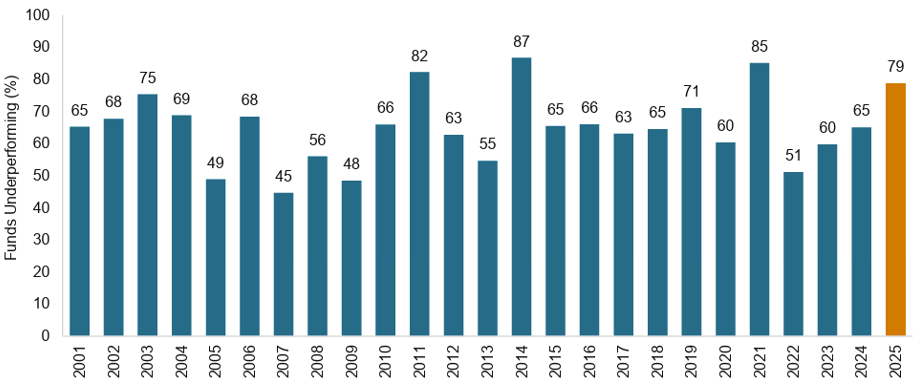
- According to the 2025 SPIVA® U.S. Scorecard, “79% of all active large-cap U.S. equity funds underperformed the S&P 500.”4
- As shown in the corresponding graph below, over the last 25 years the lowest that this percentage has been is 45 percent, meaning that even in their best year, nearly half of all actively managed large-cap U.S. funds underperformed the broader stock market.5
- And when you increase the timeframe, the statistics only get worse. In the table below we can see that the 79 percent underperformance in 2025 increases to between 86 and 93 percent when looking at 5-to-20-year time horizons.6

So, how do I invest my own money?
Mostly the same way that I’ve been describing above – I would never recommend investments to my clients that I’m not willing to invest in (or that I’m not already invested in) myself!
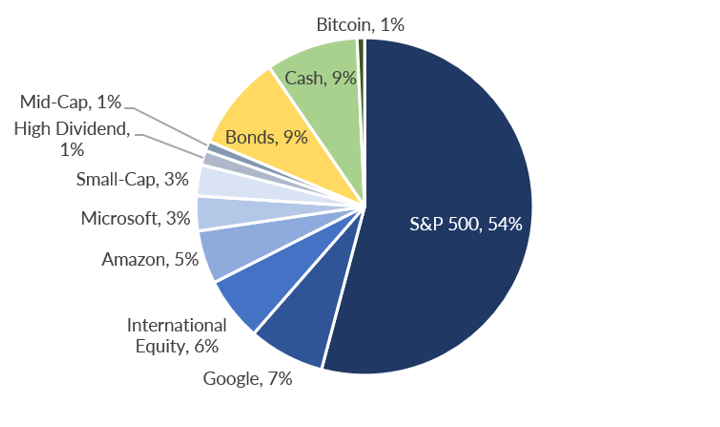
While I won’t publish individual dollar amounts behind my personal investment portfolio, in the spirit of full transparency the chart below shows the asset allocation of my current investment portfolio as of the date of this post. Over 50 percent of all of my money is invested in S&P 500 index funds. I have nearly 10 percent of my money in liquid cash investments, and about the same amount in bond index funds. The remaining 25 percent or so of my portfolio is invested in a variety of different holdings.7
*Note: Personal holdings are shown for illustrative purposes only and do not constitute investment advice or a recommendation to buy or sell any specific security, and may change without notice.
Are index funds right for me?
While broad-market index funds form an ideal foundation for most long-term investors, the right asset allocation depends entirely on your time horizon, cash flow needs, and risk tolerance. Building an investment strategy isn’t about predicting what tomorrow’s headlines will do to the market – it’s about having a disciplined, cost-effective framework that works for you over decades. If you’d like to review your current investment portfolio allocation and fee structure, feel free to reach out to me.
- A list of all 500 companies currently part of the S&P 500 is presented here: https://www.slickcharts.com/sp500 ↩︎
- S&P 500: The Gauge of the U.S. Large-Cap Market. S&P Dow Jones Indices LLC. ↩︎
- Past performance does not guarantee future results. Indexes are unmanaged and cannot be invested in directly. ↩︎
- Ganti, Anu et al. SPIVA U.S. Year-End 2025 Scorecard, S&P Dow Jones Indices LLC, March 3, 2026. ↩︎
- Ganti, Anu et al. SPIVA U.S. Year-End 2025 Scorecard, S&P Dow Jones Indices LLC, March 3, 2026. ↩︎
- Ganti, Anu et al. SPIVA U.S. Year-End 2025 Scorecard, S&P Dow Jones Indices LLC, March 3, 2026. ↩︎
- You might notice that within this remaining allocation, I hold a few individual company stocks (Google, Amazon, and Microsoft) alongside my core index fund positions. I consider these positions to be investments in companies I believe in – they are “buy-and-hold” positions for the long-term, as opposed to daytrading positions where I am trying to outsmart the market. ↩︎