Do you know how much you pay in fees from your investment accounts?
If not, it’s something you should probably look into. The fees you pay now, even if they seem small, can have a significant impact on the potential growth of your investments in the future. In this post, I will walk you through the most common types of fees you are likely paying right now, and provide you with some illustrations of why even small differences in these amounts can make a big impact on the future value of your investments.
There are several types of fees that people can pay from their investment accounts,1 but the two main ones these days are the following:
Advisory Fees: These are fees paid directly to a financial advisor like me. These may be called asset management fees, investment advisory fees, or something similar. These fees are most often calculated as a percentage of the total value of your investment account (often referred to as assets under management, or “AUM”) and are usually deducted directly from your investment account on a quarterly basis. If you know what to look for, you will see these fees on your account statements.2 In general, the average fee paid to a financial advisor approximates 1 percent of AUM.3
Product Fees (e.g., Expense Ratios): These are ongoing fees that you pay for investing in specific investment products. These fees are used to support the administrative and operating expenses of individual investment fund companies. Unlike advisory fees, you won’t see these deducted from your account statement. Instead, these fees are embedded in the performance of the underlying investment itself. The expense ratio is why index funds that track the S&P 500 will typically still underperform the S&P 500 ever so slightly. As discussed in my post on my investment philosophy, index funds and other passively-managed investment funds typically have lower fees (often expense ratios between 0.02 percent and 0.25 percent) relative to actively-managed funds, which carry higher fees (often expense ratios between 0.50 percent and 1.5 percent).4
So, all these fees are just the cost of investing, right?
Well, in my view—they don’t have to be. While some costs may be justified, every dollar you pay in fees is a dollar that could otherwise be growing in your favor, which is why fees should be minimized as much as possible.
To see the hidden impact of fees, consider the following scenario:
Imagine you meet with a financial advisor, and he or she tells you that if you enter into an agreement with their firm, you will pay a 1 percent advisory fee. Doesn’t seem too bad, right? That is the average fee, after all.
Now, let’s assume that once the ink is dry on that agreement, your financial advisor picks a variety of different mutual funds to invest your money in. On average, let’s say that the expense ratio on these funds is about 0.50 percent.
So, in this example, you would be paying 1.50 percent each year in fees. That still doesn’t sound like a whole lot. What’s the big deal?
To help illustrate the impact of this fee structure over time, assume you had $100,000 to invest. Assume that on average, the stock market returned 10 percent per year over the next 30 years. What would your investments be worth if you had just invested that money in low-cost index funds? As shown below, approximately $1.745 million dollars.5 Not too shabby for a simple, straightforward investment strategy, right?6
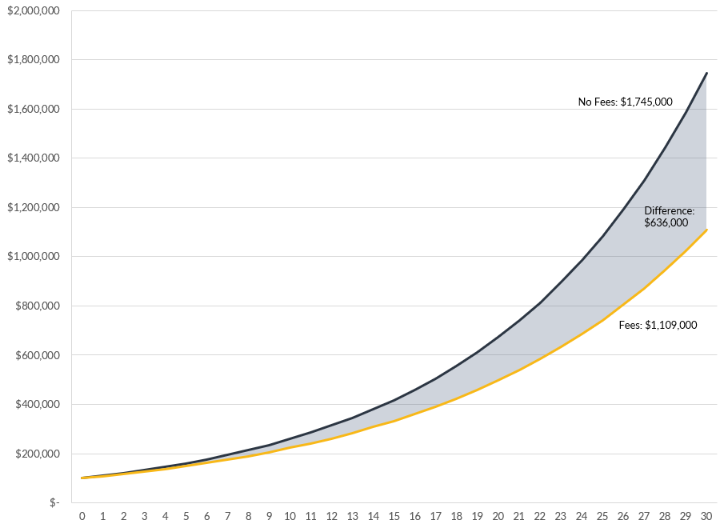
What happens if you had paid 1.50 percent in total fees each year instead? Well, as shown above, your investment portfolio would be worth only about $1.109 million at the end of 30 years – over $635,000 less because of that “small” 1.50% fee.
For a lot of people, having $1.1 million would still be a lot of money after 30 years. That said, it sure seems like a pretty big difference from the $1.7 million you would have without that “small” 1.50 percent fee, right? So where did that money go?
Well, the breakdown is as follows:
- Approximately $133,000 would have gone to your financial advisor over the course of those 30 years. In the first year, you would have paid your financial advisor $1,100, but by year 30 you would be paying him or her over $11,000 each year.
- Just over $66,000 would have gone to the investment fund that your financial advisor invested you in.
- And the remaining $437,000? Where does that go? Well, nobody gets that! That is the money that you would have earned on the money that you paid to your financial advisor and the investment fund over those 30 years if it had remained invested in your portfolio instead. Crazy, right?
In short, minimizing the fees you pay has a major impact on the growth of your investment portfolio – even if the fees seem “small” on a percentage basis.
Many traditional financial advisors will gloss over this math. They may also develop investment portfolios for you using high-cost actively-managed funds with significant expense ratios on top of the advisory fees that they are charging you. Now that you’ve read this post, if you are interviewing potential financial advisors, don’t ever hesitate to ask them these fee-related questions, and see what their answers are:
- What advisory fee do you charge?
- How much is that advisory fee, in terms of nominal dollars, for an investment portfolio like mine?
- What are the expense ratios on the investment funds that you would recommend for me?
- Do you invest any of your own money in these same investment funds? If so, what percentage of your personal portfolio? If not, why not?
As a financial advisor, my investment philosophy focuses on eliminating unnecessary costs so your money works for you, and not for large investment fund companies. That means building portfolios primarily anchored by low-cost, broad-market index funds – which cost just pennies per thousand dollars invested. It also means being completely transparent about my advisory fees. A financial planning relationship should create positive value for your portfolio, as opposed to resulting in a silent drag on your wealth.
If you aren’t sure what you are paying in total fees across your 401(k)s, IRAs, or brokerage accounts, let’s run the numbers. Reach out for a complimentary portfolio and fee analysis – we’ll break down your underlying fund expenses, uncover any hidden fees, and ensure your investment strategy is set up to maximize your wealth for the long term.
- Other fees potentially exist aside from those listed here, including account maintenance fees with your custodian and trading/transaction fees for buying or selling specific investments. Because these other fees are becoming increasingly rare, I have decided to focus on the two major categories of fees for purposes of this post. ↩︎
- Not all financial advisors earn an investment advisory fee directly from their clients, but instead may earn commissions on products they recommend to clients, or some combination of both. ↩︎
- Bradley, Jordyn. How Much Does A Financial Advisor Cost? Forbes. June 29, 2022. ↩︎
- Hayes, Adam. Understanding Fund Expense Ratios: Impact on Investment Returns. Investopedia.com. September 2, 2026. ↩︎
- For purposes of this calculation, I have omitted consideration of the small expense ratio (typically around 0.02-0.03%) that you would pay if you invested in low-cost S&P 500 index funds. ↩︎
- Disclosure: This scenario is a hypothetical illustration intended solely for educational purposes and does not represent actual performance or predict future results. The model assumes an initial investment of $100,000, a constant 10 percent annual gross rate of return compounded over 30 years with all distributions reinvested, and no intermediate contributions, withdrawals, or tax implications. Actual market results fluctuate significantly year-to-year, and investing involves the risk of loss. ↩︎